My Biggest Technology Love - How I Met the Mac
A bit late for birthday wishes – but anyway: HAPPY 30th BIRTHDAY MACINTOSH! And it’s the best opportunity for at least the next 10 years to tell the story of
This is a beautiful and powerful statement what Apple is trying to do.

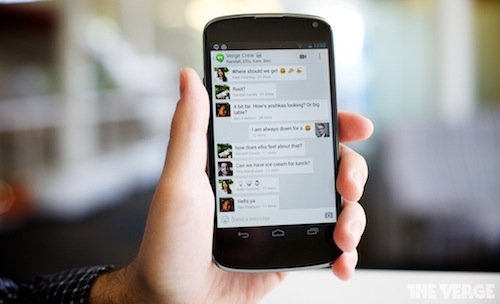
The new unified messaging app by Google: Hangouts (Copyright The Verge)
The Google I/O keynote has just ended and although the Verge’s verdict is “The moonshots, it seems, will have to wait“, I think they’ve presented some great new and updated products. Even though they left Gmail and Docs out, their product refresh feels pretty much like Apple redoing their entire hardware lineup (which they almost did last autumn):
Not too bad, I’d say. And it shows one thing: Google is not slowing down with what they know best – building great web services. At the same time they’re flexing their muscles in hardware design and seem to have built a great looking and great feeling machine with the Google Pixel.
In the meantime Apple’s web services haven’t really shined. Some streets and bridges seem to be made of molasses in the Maps app (if they are at the right spot at all), iCloud document syncing is really limited – no sharing across apps, across people and (obviously) beyond the Apple ecosystem – and seems to be buggy and a nightmare to develop for. Siri is still a hit or miss for me and anyway I don’t use it much – although I’m sure it has a lot of potential. Pando Daily commented the Google I/O announcements with “Google is keeping iCloud’s promises”
In John Gruber’s words: “Google is getting better at what Apple does best faster than Apple is getting better at what Google does best.”
Please Apple, can we reverse this trend at WWDC? I want to see some updates to Apple’s web services that knock me out, some real magical and “just works” iCloud syncing (and why not finally buy Dropbox…?) and Siri features that are so bloody useful that I wouldn’t mind any more that I’m chatting with a robot in my phone.
But that’s a tough call: Google has shown today that while they’re getting better at Apple’s design game they’re not slowing down in the web services game. And running faster than the leader after having stumbled a few times is going to be hard for Apple.
The new unified messaging app by Google: Hangouts (Copyright The Verge) The Google I/O keynote has just ended and although the Verge’s verdict is “The moonshots, it seems,
The more I hear the expression the less appropriate the term “post-PC” seems to me. Post-PC only makes sense in a historical view in which the Personal Computer (PC – and here including Macs) is defined as the computer as we know it: our desktop computer or laptop of choice.
“Personal” in this context mostly only makes sense as the revolutionary step that made computers available to normal people, made them personal. The revolution was to make these machines affordable enough to be bought and usable enough to be understood by a regular person. And obviously both of these aspects have improved tremendously since the first build-it-yourself PC-kits were sold by Steve Wozniak and Steve Jobs.
But all of this doesn’t make the PC truly personal. The only actual personal computer you own is your smartphone.
How personal is a traditional PC in the actual sense of the word? How much does a PC belong to you as a person or reflect who you are? The longer you use it, the more of your personal data it stores: your photos, your emails, your thoughts expressed in whatever written word you create and even your DNA through your hair that falls between the cracks into its keyboard. It knows about your contacts and your calendar and about the work you do.
However all of this doesn’t make the PC truly personal. The only actual personal computer you own is your smartphone: it knows where you are, what caught your interest just now when you’re taking a photo, what you’re thinking right know when you send out a spontaneous tweet and even when you take a dump, since many of us (myself included) take it with us to the bathroom. The smartphone again may be replaced by some even more personal computer in the form of a wearable computing devices in the near or not so near future.
We are not moving beyond the Personal Computer as the term post-PC evokes. We are actually evolving towards ever more personal computers until one day they may literally be part of who and what we are.
The more I hear the expression the less appropriate the term “post-PC” seems to me. Post-PC only makes sense in a historical view in which the Personal Computer (PC – and
Everybody knows these mobile phone shops: rows and rows of shiny new gadgets attached to some security device that beeps horribly if you pull a bit too harshly on the string attached to the phone you want to try out. How on earth have these shops and their terrible user experience changed so little? Some observations about what is wrong with the customer experience.
Some time ago I was waiting for my turn at our local Orange shop. As anybody reading this piece probably knows, I’ll most likely be one of the very last people to switch away from my beloved iPhone. But hey, I had a couple of minutes and there was a row of smartphones from all the companies and mobile phone platforms known to man in front of me, why not give them a spin? Does Windows Phone really look and feel that cool? How is it that Samsung seems to produce some worthy competition for the iPhone? Questions that needed to be answered someday!
Have tech retailers really learnt nothing in the twelve years since the first Apple Store?
But, alas, it was not this day or any other day in a regular mobile phone shop for that matter. Why? These things, though very nice feeling phones, were totally useless for checking out some of the most common features:
How the hell am I supposed to find out if this phone is any good? How shall I experience its web browser, email app, and great screen if there is no connection to the web, no configured email account, and no gorgeous pictures in the photo gallery app? Have tech retailers really learned nothing in the twelve years since the first Apple Store? The only thing that is better than it used to be: you usually won’t find any of those ugly fake phones with a sticker as their screen anymore – they’ve learned that. A next post will be about why this might be the case. But until then let’s look at somebody who seems to have nailed it.
Everybody knows these mobile phone shops: rows and rows of shiny new gadgets attached to some security device that beeps horribly if you pull a bit too harshly on the
It is a false and foolish but widespread misconception that “innovation” goes only in the direction of additional complexity. Read More