What is Strategy? It's About Choices.
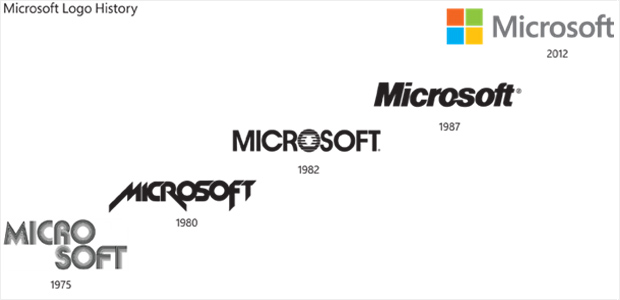
Microsoft logo history (copyright http://techenjoy.com) So today Microsoft announced a huge reorganization and you can find this gem in the memo about the move: Going forward, our strategy
So today Microsoft announced a huge reorganization and you can find this gem in the memo about the move:
Going forward, our strategy will focus on creating a family of devices and services for individuals and businesses that empower people around the globe at home, at work and on the go, for the activities they value most.
So lets take this apart with the trusted “who, what, how” of business strategy 101:
So this is the new “one Microsoft” – is it too big to be one? Was it really so bad, when every product or product line could define its own distinct strategy and target segment? What we have now is a fluffy sentence that isn’t defining a clear strategic positioning at all.
Microsoft logo history (copyright http://techenjoy.com) So today Microsoft announced a huge reorganization and you can find this gem in the memo about the move: Going forward, our strategy
This is a beautiful and powerful statement what Apple is trying to do.

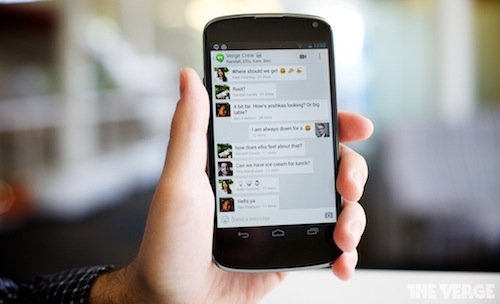
The new unified messaging app by Google: Hangouts (Copyright The Verge)
The Google I/O keynote has just ended and although the Verge’s verdict is “The moonshots, it seems, will have to wait“, I think they’ve presented some great new and updated products. Even though they left Gmail and Docs out, their product refresh feels pretty much like Apple redoing their entire hardware lineup (which they almost did last autumn):
Not too bad, I’d say. And it shows one thing: Google is not slowing down with what they know best – building great web services. At the same time they’re flexing their muscles in hardware design and seem to have built a great looking and great feeling machine with the Google Pixel.
In the meantime Apple’s web services haven’t really shined. Some streets and bridges seem to be made of molasses in the Maps app (if they are at the right spot at all), iCloud document syncing is really limited – no sharing across apps, across people and (obviously) beyond the Apple ecosystem – and seems to be buggy and a nightmare to develop for. Siri is still a hit or miss for me and anyway I don’t use it much – although I’m sure it has a lot of potential. Pando Daily commented the Google I/O announcements with “Google is keeping iCloud’s promises”
In John Gruber’s words: “Google is getting better at what Apple does best faster than Apple is getting better at what Google does best.”
Please Apple, can we reverse this trend at WWDC? I want to see some updates to Apple’s web services that knock me out, some real magical and “just works” iCloud syncing (and why not finally buy Dropbox…?) and Siri features that are so bloody useful that I wouldn’t mind any more that I’m chatting with a robot in my phone.
But that’s a tough call: Google has shown today that while they’re getting better at Apple’s design game they’re not slowing down in the web services game. And running faster than the leader after having stumbled a few times is going to be hard for Apple.
The new unified messaging app by Google: Hangouts (Copyright The Verge) The Google I/O keynote has just ended and although the Verge’s verdict is “The moonshots, it seems,
The more I hear the expression the less appropriate the term “post-PC” seems to me. Post-PC only makes sense in a historical view in which the Personal Computer (PC – and here including Macs) is defined as the computer as we know it: our desktop computer or laptop of choice.
“Personal” in this context mostly only makes sense as the revolutionary step that made computers available to normal people, made them personal. The revolution was to make these machines affordable enough to be bought and usable enough to be understood by a regular person. And obviously both of these aspects have improved tremendously since the first build-it-yourself PC-kits were sold by Steve Wozniak and Steve Jobs.
But all of this doesn’t make the PC truly personal. The only actual personal computer you own is your smartphone.
How personal is a traditional PC in the actual sense of the word? How much does a PC belong to you as a person or reflect who you are? The longer you use it, the more of your personal data it stores: your photos, your emails, your thoughts expressed in whatever written word you create and even your DNA through your hair that falls between the cracks into its keyboard. It knows about your contacts and your calendar and about the work you do.
However all of this doesn’t make the PC truly personal. The only actual personal computer you own is your smartphone: it knows where you are, what caught your interest just now when you’re taking a photo, what you’re thinking right know when you send out a spontaneous tweet and even when you take a dump, since many of us (myself included) take it with us to the bathroom. The smartphone again may be replaced by some even more personal computer in the form of a wearable computing devices in the near or not so near future.
We are not moving beyond the Personal Computer as the term post-PC evokes. We are actually evolving towards ever more personal computers until one day they may literally be part of who and what we are.
The more I hear the expression the less appropriate the term “post-PC” seems to me. Post-PC only makes sense in a historical view in which the Personal Computer (PC – and
Recently the FT took a critical look at what apparently is being derided as “innovation tourism”: these organized tours of company executives spending a week in Silicon Valley and hoping to bring something useful back home.
I plead guilty: Working for a media company mostly stuck in the analog world? Check. Staying for just a short week and expecting some sort of enlightenment? Check. Hitting the hard wall of reality when I got back? Check…

Still my trip to the Silicon Valley this March was enlightening, like taking a glimpse at a not so distant future. Last time I have been in the area was in 2008: Apple had not released a way to develop apps for the iPhone yet, the iPad was two years away, Android smartphones were being tested in some secret Google lab and Twitter hadn’t really gone mainstream yet.
A lot has changed since! The evening I arrived, I took three cabs and two of them took my credit card with a Square-dongle attached to their smartphone. I communicated with the group I was about to meet through Twitter. Anything I wanted to find, was a tap away on my smartphone: the way to my Airbnb accomodation, great restaurants in the area with many and actually helpful reviews and finding a cab where none was around with uber.
In Switzerland I’m an avid foursquare-user, just for the fun of it. But have I ever had an actual benefit from giving my location in Switzerland to some random startup company? Not really. In the Bay Area foursquare actually works as it’s supposed to: there are specials in many cafés and a department store even asks you how you enjoyed it a day after you shopped there (a little bit creepy, I agree – but then again: I decided to check in…).
you need to think about the short term because the long term implications of the digital and mobile disruption are at most a gut feeling
How is all of this relevant to my employer? Will we launch our own social-mobile-local network? No way. The most relevant and also the hardest part to bring back home is the mindset:
This Silicon Valley reality is to a large extent theory in most corporate environments. So how can we bring about change? Those might be some steps to create more of a startup or Valley-feeling even in the most rusty corporate environment:
But most of all: start taking risks and reward success as well as failure, if failure means trying something new and learning from it. Be more daring, get out of your comfort zone and build something new instead of finding all the reasons why your idea won’t work anyway. Don’t listen to the naysayers, go out and do. This is what we can learn from startups all over the world and especially from the Valley: go out and build something new – not trying is the worst failure of all.
Recently the FT took a critical look at what apparently is being derided as “innovation tourism”: these organized tours of company executives spending a week in Silicon Valley and hoping
About the term “curation”:
when I talk to journalists I always have to be like, ‘Actually, curation – it’s really what you guys have always done.’ It’s taking a lot of information, pulling out the relevant parts of it, giving context, and telling a story.
About how traditional media companies first (sometimes still) reacted to the Internet:
it was clearly disrupting newspapers who didn’t seem to know how to deal with it, or grasping onto the old world and hoping all this Internet stuff would go away.
Great guy, go read the interview!
About the term “curation”: when I talk to journalists I always have to be like, ‘Actually, curation – it’s really what you guys have always done.’ It’s taking a

The normal distribution – beautiful curve and rules statistics and data
Big data, small data, personal data, data infrastructure, data here, data there: I generally hate buzz word bingo. But for a change, I actually believe in the impact of data and clearly we have more data at our disposal than ever before. Question is: how can we use it in new ways to create new businesses? We looked for some answers at The Hive chatting with T.M. Ravi.
According to Ravi all companies and all parts of a company will be transformed by the use of data. What we see today is just the first step for building data driven businesses: companies like Google, Facebook, Twitter or LinkedIn mostly just built a powerful infrastructure to collect data in the digital space. Actually these companies have built almost addictive platforms to let us, its users, give them all the data they might dream of. The next step however is how we collect and use data from the analog world. Google is doing so with StreetView, but think about pretty much any object being connected to the Internet and collecting data or being a data object in itself. All any company then needs to master is processing data and sucking the value out that lies in it.
Wining and dining the advertisers in the old Mad Men way won’t do it: Embrace change and new technologies like real time bidding, behavioral targeting and performance marketing – we are just at the beginning of the data revolution.
In a field nearer to my home turf this is already having a huge impact: online advertising. This industry is totally driven by data today and the value lies in targeting and personalization of advertising. For example during a real time bidding process on an ad impression the machines involved can estimate how much to bid by using personal or behavioral data about the user. If you don’t use this technology, you’re being out-bid by the smarter machine – or, from the publisher’s point of view, you won’t be able to get the best price for your ad inventory, if you don’t provide data about your users.
That is a huge challenge to our traditional business of selling high-CPM brand advertising. In the words of Ravi: “brand advertising is getting squeezed by performance advertising, because performance can be measured very well.” And what do marketing executives love? A measurable ROI in terms of sales and not some fuzzy brand awareness or other rather soft measure.
What to do? Wining and dining the advertisers in the Mad Men way won’t do it: Embrace change and new technologies like real time bidding, behavioral targeting and performance marketing – we are just at the beginning of the data revolution.
— Still digesting insights from my Silicon Valley trip… This one is related to this post (in german).
The normal distribution – beautiful curve and rules statistics and data Big data, small data, personal data, data infrastructure, data here, data there: I generally hate buzz word bingo. But for
On march 2nd 2013 Evernote was the victim of a security breach on their servers. For a service that holds so much private information about its users, actually also about me, this could be life-threatening incident. As such many a company would prefer to not talk about it. Especially if, as it was the case with the Evernote hack attack, no data and payment information seemed to have been accessed, changed or deleted.
Andrew Sinkov, VP of Marketing at Evernote, about the security breach:
“That sucked! What you do about it, is to be as transparent as possible as quickly as possible.”
Not so with Evernote: they had a plan in place for such an incident and the guiding principle was to keep absolute transparency about what had happened and to take any possible action in order to protect the users’ data. So they addressed all their users in an mass emailing, informed all major media outlets and implemented a system-wide password reset.

Evernote mass email informing all users about the security breach and the system-wide password reset
At our visit at the Evernote HQ the topic of the hacking attack was no taboo at all. Andrew Sinkov, Evernote’s VP of Marketing, was very open about it: “That sucked! What you do about it, is to be as transparent as possible as quickly as possible.” Ronda Scott, responsible for PR & communication, explained us that Evernote received a lot of positive reactions to how they handled the security breach. According to her this is how Phil Libin, Evernote’s CEO and founder, envisions the company: always be open and transparent and do the right thing.
For a service that should help its customers expand their memory by remembering everything, trust is crucial. But nothing kills trust faster than not being transparent – Evernote is on the right track here, let’s hope they keep it up and succeed in building “a 100 year company”.
On march 2nd 2013 Evernote was the victim of a security breach on their servers. For a service that holds so much private information about its users, actually also about